Home / Past papers / MAD1 Quiz 2 / this paper
IIT M DIPLOMA AN EXAM QDD2 01 Dec 2024 - 01 Dec 2024
Elapsed 00:00
You have a DRAM module with bus width of 64 bits, clock speed of 800 MHz, and operating in DDR (double-data-rate or two values per clock cycle) mode. What is the maximum memory bandwidth in Gigabytes per second achievable with this module if it is working in dual channel mode (two memory interfaces are used)?
- 51.2
- 102.4
- 25.6
- 12.8
Text of the picture (copyable)
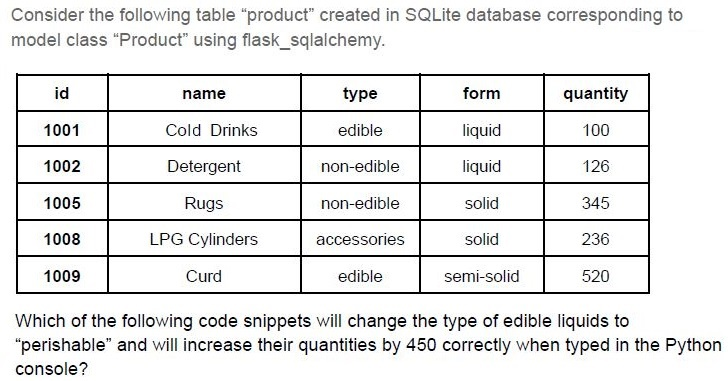
Consider the following table "product" created in SQLite database corresponding to model class "Product" using flask_sqlalchemy.

| id | name | type | form | quantity |
|---|---|---|---|---|
| 1001 | Cold Drinks | edible | liquid | 100 |
| 1002 | Detergent | non-edible | liquid | 126 |
| 1005 | Rugs | non-edible | solid | 345 |
| 1008 | LPG Cylinders | accessories | solid | 236 |
| 1009 | Curd | edible | semi-solid | 520 |

Which of the following code snippets will change the type of edible liquids to "perishable" and will increase their quantities by 450 correctly when typed in the Python console?
text
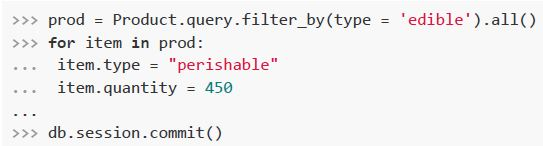
```python
>>> prod = Product.query.filter_by(type = 'edible').all()
>>> for item in prod:
...     item.type = "perishable"
...     item.quantity = 450
...
>>> db.session.commit()
```
text
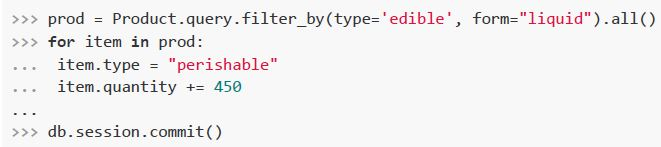
```python
>>> prod = Product.query.filter_by(type='edible', form="liquid").all()
>>> for item in prod:
...     item.type = "perishable"
...     item.quantity += 450
...
>>> db.session.commit()
```
text
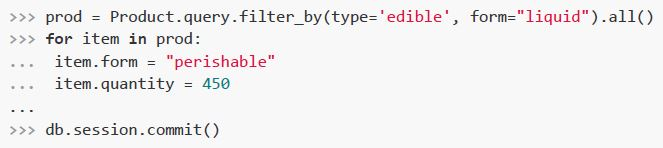
```python
>>> prod = Product.query.filter_by(type='edible', form="liquid").all()
>>> for item in prod:
...    item.form = "perishable"
...    item.quantity = 450
...
>>> db.session.commit()
```
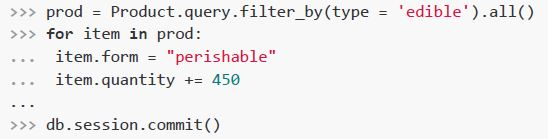
text
```python
>>> prod = Product.query.filter_by(type = 'edible').all()
>>> for item in prod:
...     item.form = "perishable"
...     item.quantity += 450
...
>>> db.session.commit()
```
Text of the picture (copyable)
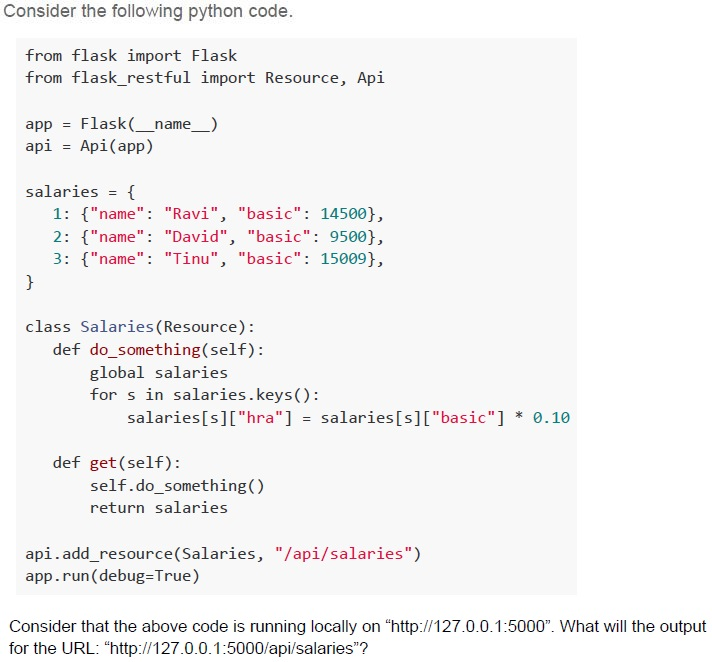
Consider the following python code.

```python
from flask import Flask
from flask_restful import Resource, Api

app = Flask(__name__)
api = Api(app)

salaries = {
    1: {"name": "Ravi", "basic": 14500},
    2: {"name": "David", "basic": 9500},
    3: {"name": "Tinu", "basic": 15009},
}

class Salaries(Resource):
    def do_something(self):
        global salaries
        for s in salaries.keys():
            salaries[s]["hra"] = salaries[s]["basic"] * 0.10

    def get(self):
        self.do_something()
        return salaries

api.add_resource(Salaries, "/api/salaries")
app.run(debug=True)
```

Consider that the above code is running locally on "http://127.0.0.1:5000". What will the output for the URL: "http://127.0.0.1:5000/api/salaries"?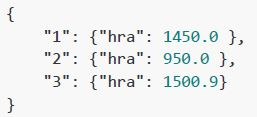
text
```json
{
    "1": {"hra": 1450.0 },
    "2": {"hra": 950.0 },
    "3": {"hra": 1500.9}
}
```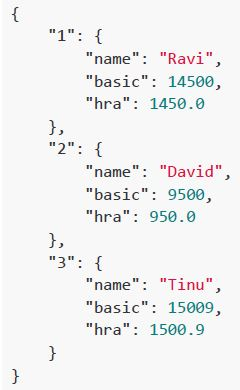
text
```json
{
    "1": {
        "name": "Ravi",
        "basic": 14500,
        "hra": 1450.0
    },
    "2": {
        "name": "David",
        "basic": 9500,
        "hra": 950.0
    },
    "3": {
        "name": "Tinu",
        "basic": 15009,
        "hra": 1500.9
    }
}
```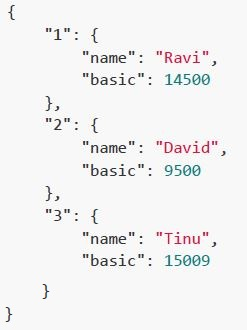
text
```json
{
  "1": {
    "name": "Ravi",
    "basic": 14500
  },
  "2": {
    "name": "David",
    "basic": 9500
  },
  "3": {
    "name": "Tinu",
    "basic": 15009
  }
}
```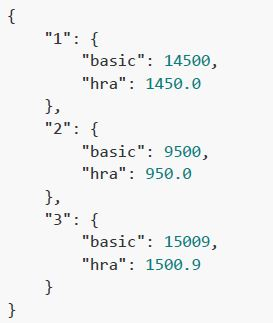
text
```json
{
  "1": {
    "basic": 14500,
    "hra": 1450.0
  },
  "2": {
    "basic": 9500,
    "hra": 950.0
  },
  "3": {
    "basic": 15009,
    "hra": 1500.9
  }
}
```
Text of the picture (copyable)
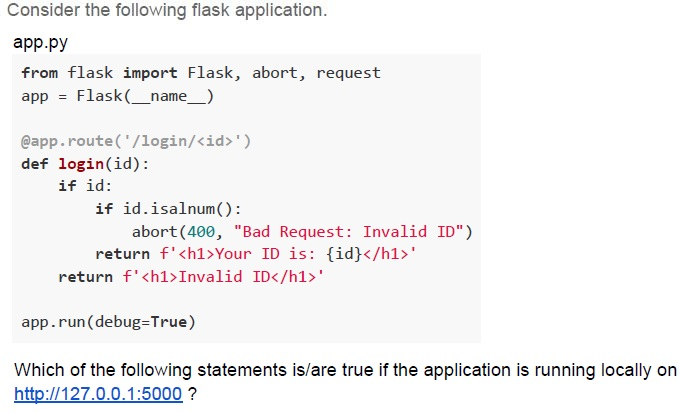
Consider the following flask application.

app.py
```python
from flask import Flask, abort, request
app = Flask(__name__)

@app.route('/login/<id>')
def login(id):
    if id:
        if id.isalnum():
            abort(400, "Bad Request: Invalid ID")
        return f'<h1>Your ID is: {id}</h1>'
    return f'<h1>Invalid ID</h1>'

app.run(debug=True)
```

Which of the following statements is/are true if the application is running locally on http://127.0.0.1:5000 ?
text
For URL http://127.0.0.1:5000/login?id=MAD-I the browser will render
Not Found

text
For URL http://127.0.0.1:5000/login/ the browser will render
**Invalid ID**

text
For URL http://127.0.0.1:5000/login/CS2003 the browser will render Bad
Request: Invalid ID

text
For URL http://127.0.0.1:5000/login/PDSA the browser will render Bad
Request: Invalid ID
Text of the picture (copyable)
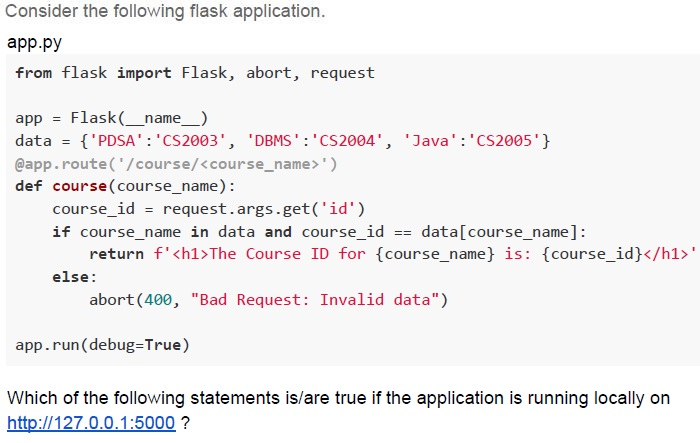
Consider the following flask application.
app.py
```python
from flask import Flask, abort, request

app = Flask(__name__)
data = {'PDSA':'CS2003', 'DBMS':'CS2004', 'Java':'CS2005'}
@app.route('/course/<course_name>')
def course(course_name):
    course_id = request.args.get('id')
    if course_name in data and course_id == data[course_name]:
        return f'<h1>The Course ID for {course_name} is: {course_id}</h1>'
    else:
        abort(400, "Bad Request: Invalid data")

app.run(debug=True)
```
Which of the following statements is/are true if the application is running locally on
http://127.0.0.1:5000 ?
text
For URL http://127.0.0.1:5000/PDSA?id=CS2003 the browser will render;
**Not Found**

text
For URL http://127.0.0.1:5000/course/Java?id=CS2005 the browser will
render;
**The Course ID for Java is: CS2005**

text
For URL http://127.0.0.1:5000/course?course_name=DBMS&id=CS2004 the
browser will render;
**The Course ID for DBMS is: CS2004**

text
For URL http://127.0.0.1:5000/course/DBMS?id=CS2003 the browser will
render;
Bad Request: Invalid data
Consider the following HTML document “form.html” and the flask route given in “app.py”. Assume all the required methods are imported, Which of the following statements is/are correct.
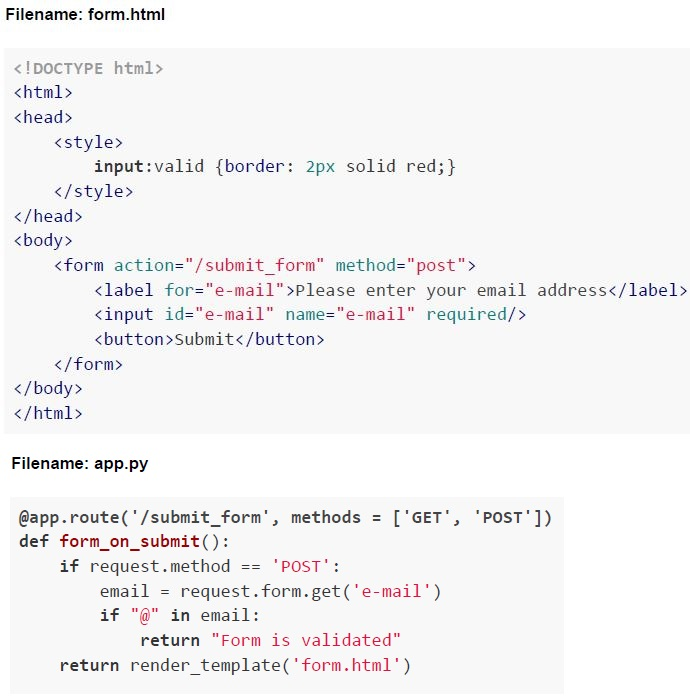 Consider the following HTML document “form.html” and the flask route given in “app.py”. Assume all the required methods are imported, Which of the following statements is/are correct.
Text of the picture (copyable)
Filename: form.html

```html
<!DOCTYPE html>
<html>
<head>
    <style>
        input:valid {border: 2px solid red;}
    </style>
</head>
<body>
    <form action="/submit_form" method="post">
        <label for="e-mail">Please enter your email address</label>
        <input id="e-mail" name="e-mail" required/>
        <button>Submit</button>
    </form>
</body>
</html>
```

Filename: app.py

```python
@app.route('/submit_form', methods = ['GET', 'POST'])
def form_on_submit():
    if request.method == 'POST':
        email = request.form.get('e-mail')
        if "@" in email:
            return "Form is validated"
    return render_template('form.html')
```- The above HTML document has frontend validation incorporated, usingHTML5 form validation.
- The above HTML document has only backend validation incorporated.
- The above HTML document has both frontend and backend validationincorporated.
- If the e-mail input field is left blank, the border colour of the input field will bered.
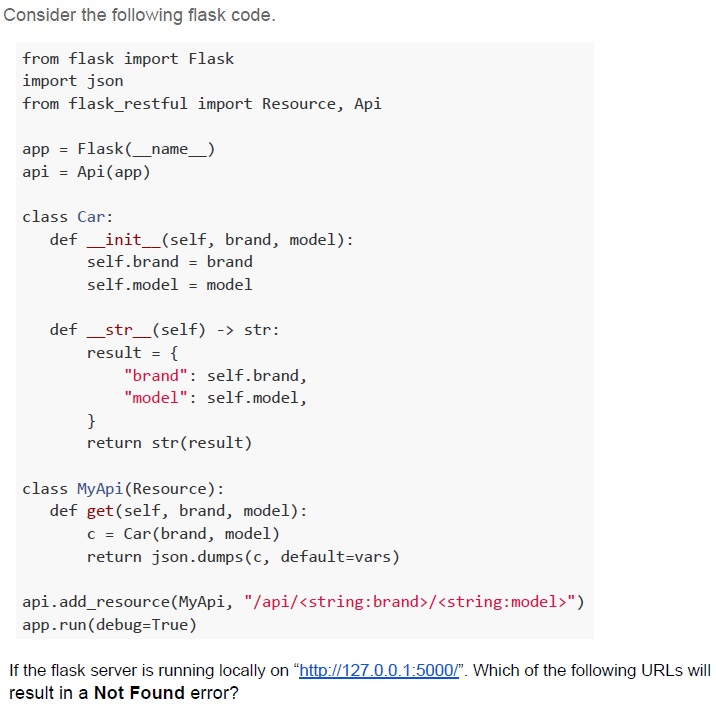
Text of the picture (copyable)
Consider the following flask code.

```python
from flask import Flask
import json
from flask_restful import Resource, Api

app = Flask(__name__)
api = Api(app)

class Car:
    def __init__(self, brand, model):
        self.brand = brand
        self.model = model

    def __str__(self) -> str:
        result = {
            "brand": self.brand,
            "model": self.model,
        }
        return str(result)

class MyApi(Resource):
    def get(self, brand, model):
        c = Car(brand, model)
        return json.dumps(c, default=vars)

api.add_resource(MyApi, "/api/<string:brand>/<string:model>")
app.run(debug=True)
```

If the flask server is running locally on "http://127.0.0.1:5000/". Which of the following URLs will result in a Not Found error?
text
http://127.0.0.1:5000/api/maruti/swift

text
```
http://127.0.0.1:5000/api/brand=Hyundai/model=Creta
```

text
```
http://127.0.0.1:5000/api/brand=Ford,model=Fiesta
```

text
http://127.0.0.1:5000/api/Honda&City

text
http://127.0.0.1:5000/api/model=Accent/brand=Hundai
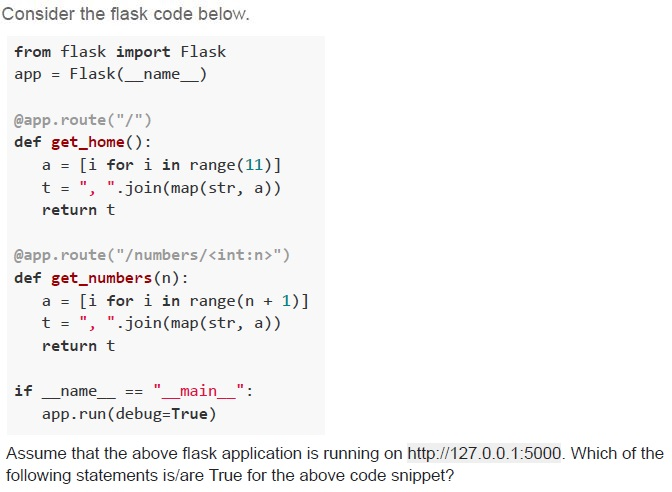
Text of the picture (copyable)
Consider the flask code below.

```python
from flask import Flask
app = Flask(__name__)

@app.route("/")
def get_home():
    a = [i for i in range(11)]
    t = ", ".join(map(str, a))
    return t

@app.route("/numbers/<int:n>")
def get_numbers(n):
    a = [i for i in range(n + 1)]
    t = ", ".join(map(str, a))
    return t

if __name__ == "__main__":
    app.run(debug=True)
```

Assume that the above flask application is running on http://127.0.0.1:5000. Which of the following statements is/are True for the above code snippet?
text
URL : http://127.0.0.1:5000/
Output: 0, 1, 2, 3, 4, 5, 6, 7, 8, 9, 10

text
URL: http://127.0.0.1:5000/numbers/5
Output: 0, 1, 2, 3, 4, 5
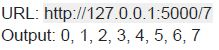
text
URL: http://127.0.0.1:5000/7
Output: 0, 1, 2, 3, 4, 5, 6, 7
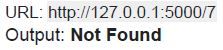
text
URL: http://127.0.0.1:5000/7
Output: **Not Found**
Consider a character set Q, which consists of only those characters used in the sentence, "the five boxing wizards jump quickly" If this sentence is to be saved in a document with minimum encoding, what will be the size of the document given that no other information or context is to be saved?
- 175 bits
- 180 bits
- 252 bits
- 256 bits
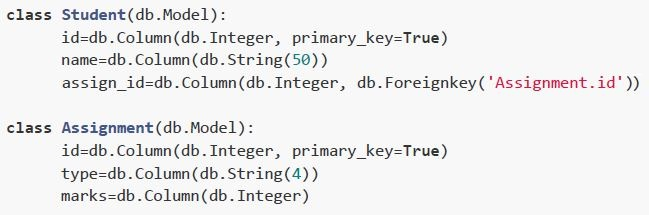
We are trying to create two models ‘Student’ and ‘Assignment’ and they are related by one-to-many relationship(i.e., one student will attempt multiple assignments). Assuming that flask_sqlalchemy is to be used to create data models, which of the following will correctly achieve the requirements?
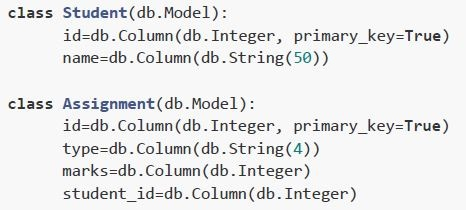
text
```python
class Student(db.Model):
    id=db.Column(db.Integer, primary_key=True)
    name=db.Column(db.String(50))

class Assignment(db.Model):
    id=db.Column(db.Integer, primary_key=True)
    type=db.Column(db.String(4))
    marks=db.Column(db.Integer)
    student_id=db.Column(db.Integer)
```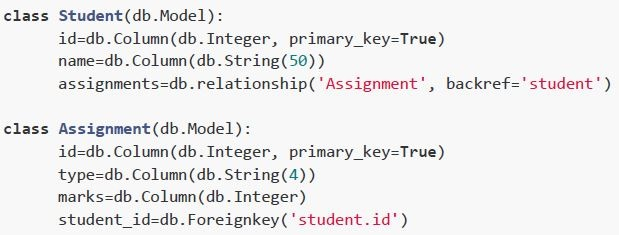
text
```python
class Student(db.Model):
    id=db.Column(db.Integer, primary_key=True)
    name=db.Column(db.String(50))
    assignments=db.relationship('Assignment', backref='student')

class Assignment(db.Model):
    id=db.Column(db.Integer, primary_key=True)
    type=db.Column(db.String(4))
    marks=db.Column(db.Integer)
    student_id=db.ForeignKey('student.id')
```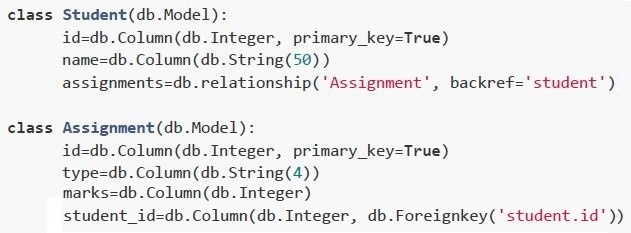
text
```python
class Student(db.Model):
    id=db.Column(db.Integer, primary_key=True)
    name=db.Column(db.String(50))
    assignments=db.relationship('Assignment', backref='student')

class Assignment(db.Model):
    id=db.Column(db.Integer, primary_key=True)
    type=db.Column(db.String(4))
    marks=db.Column(db.Integer)
    student_id=db.Column(db.Integer, db.ForeignKey('student.id'))
```
text
```python
class Student(db.Model):
    id=db.Column(db.Integer, primary_key=True)
    name=db.Column(db.String(50))
    assign_id=db.Column(db.Integer, db.Foreignkey('Assignment.id'))

class Assignment(db.Model):
    id=db.Column(db.Integer, primary_key=True)
    type=db.Column(db.String(4))
    marks=db.Column(db.Integer)
```
Comprehension passage - the questions below it refer to this
Consider the following resource created using Flask, assume that the application is running on a terminal 1 and being accessed using CURL on terminal 2. Answer the given subquestions.
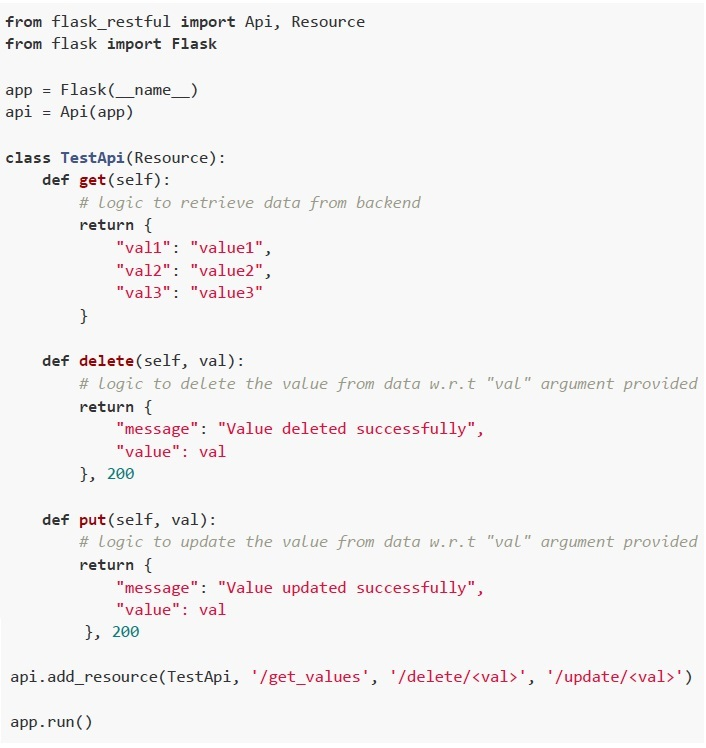 Consider the following resource created using Flask, assume that the application is running on a terminal 1 and being accessed using CURL on terminal 2. Answer the given subquestions.
What will be returned on the terminal 2 for the command:
 What will be returned on the terminal 2 for the command:
Text of the picture (copyable)
```
curl http://127.0.0.1:5000/delete/val1
```

text
```json
{"message": "Value deleted successfully", "value": "val1"}
```
text
```json
{"message": "Value updated successfully", "value": "val1"}
```
text
```json
{"val1": "value1"}
```
text
None of these.
What will be returned on the terminal 2 for the command:
 What will be returned on the terminal 2 for the command:
Text of the picture (copyable)
```
curl http://127.0.0.1:5000/delete/va11 -X PUT
```

text
```json
{
  "message": "Value deleted successfully",
  "value": "val1"
}
```
text
```json
{"message": "Value updated successfully", "value": "val1"}
```
text
```json
{"val1": "value1"}
```
text
None of these.
Which of the following statements are correct?
- HTML defines the styling, while CSS defines the content
- HTML defines the content, while CSS defines the styling
- JavaScript is always the core part of an application’s frontend
- JavaScript provides additional functionality at the frontend
Text of the picture (copyable)
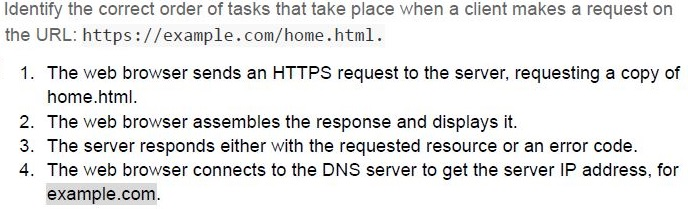
Identify the correct order of tasks that take place when a client makes a request on the URL: https://example.com/home.html.

1. The web browser sends an HTTPS request to the server, requesting a copy of home.html.
2. The web browser assembles the response and displays it.
3. The server responds either with the requested resource or an error code.
4. The web browser connects to the DNS server to get the server IP address, for example.com.
- 1-4-3-2
- 4-1-3-2
- 1-3-4-2
- 4-3-1-2
Consider the following statements and select the correct option.
Statement 1: Redundancy is used to improve performance and decrease server load. Statement 2: Replication ensures data is not lost if a copy gets destroyed.
- Statement 1 is true & statement 2 is false
- Statement 2 is true & statement 1 is false
- Both statements 1 and 2 are true
- Both statements 1 and 2 are false
The term “stateless” in the context of a server means that _________
- it is not physically located on any particular machine
- it does not have any information about the state of the client
- it is ephemeral
- All of these
Answer key
- Q1 (MCQ, 4.5 marks): C
- Q2 (MCQ, 4.5 marks): B
- Q3 (MCQ, 4.5 marks): B
- Q4 (MSQ, 3 marks): A, C, D
- Q5 (MSQ, 3 marks): A, B, D
- Q6 (MSQ, 3 marks): A, C
- Q7 (MSQ, 3 marks): C, D
- Q8 (MSQ, 3 marks): A, B, D
- Q9 (MCQ, 3 marks): B
- Q10 (MCQ, 3 marks): C
- Q11 (MCQ, 4.5 marks): D
- Q12 (MCQ, 3 marks): B
- Q13 (MSQ, 2 marks): B, D
- Q14 (MCQ, 2 marks): B
- Q15 (MCQ, 2 marks): D
- Q16 (MCQ, 2 marks): B
Concepts this paper tests
Auto-generated summary from the source site. Handy as a checklist; the lessons above explain each idea from scratch.
Summary of Core Topics, Concepts, Principles, and Equations
1. Computer Architecture and Memory Bandwidth
- Concepts: DRAM, Bus Width, Clock Speed, DDR Mode, Dual Channel Mode
- Principles: Memory Bandwidth Calculation
Equations:
- Memory Bandwidth (GB/s) = (Bus Width * Clock Speed * Data Rate * Number of Channels) / 8
- For DDR mode, Data Rate = 2 (since two values are transferred per clock cycle)
2. Database Management and SQLAlchemy
- Concepts: SQLAlchemy, ORM, Database Sessions, Query Filtering, Updating Records
- Principles: Using SQLAlchemy to interact with databases, filtering and updating records
3. Flask and RESTful APIs
- Concepts: Flask, RESTful APIs, HTTP Methods (GET, POST, PUT, DELETE), JSON Responses
- Principles: Creating and managing RESTful APIs using Flask, handling HTTP requests and responses
4. HTML and Frontend Validation
- Concepts: HTML5 Form Validation, CSS Styling, Frontend and Backend Validation
- Principles: Using HTML5 attributes for frontend validation, styling valid and invalid inputs
5. Character Encoding and Information Theory
- Concepts: Character Set, Minimum Encoding, Bit Calculation
- Principles: Calculating the size of a document based on the character set and encoding
6. Database Relationships and Flask-SQLAlchemy
- Concepts: One-to-Many Relationships, Foreign Keys, Database Models
- Principles: Creating database models with relationships using Flask-SQLAlchemy
7. CURL Commands and HTTP Methods
- Concepts: CURL, HTTP Methods (GET, PUT, DELETE), API Endpoints
- Principles: Using CURL to interact with RESTful APIs, understanding HTTP methods and responses
8. Web Development Concepts
- Concepts: HTML, CSS, JavaScript, Frontend and Backend Development
- Principles: Roles of HTML, CSS, and JavaScript in web development
9. Networking and HTTP Requests
- Concepts: DNS, HTTPS, HTTP Requests and Responses
- Principles: Steps involved in loading a web page, from DNS lookup to displaying the response
10. Server and Data Management
- Concepts: Redundancy, Replication, Stateless Servers
- Principles: Understanding redundancy and replication in server management, stateless server concept
Graph 1: Computer Architecture and Memory Bandwidth
Graph 2: Database Management and SQLAlchemy
Graph 3: Flask and RESTful APIs
Graph 4: HTML and Frontend Validation
Graph 5: Character Encoding and Information Theory
Graph 6: Database Relationships and Flask-SQLAlchemy
Graph 7: CURL Commands and HTTP Methods
Graph 8: Web Development Concepts
Graph 9: Networking and HTTP Requests
Graph 10: Server and Data Management
These graphs and summaries should help you understand the core topics and their relationships, making it easier to study for the exam.